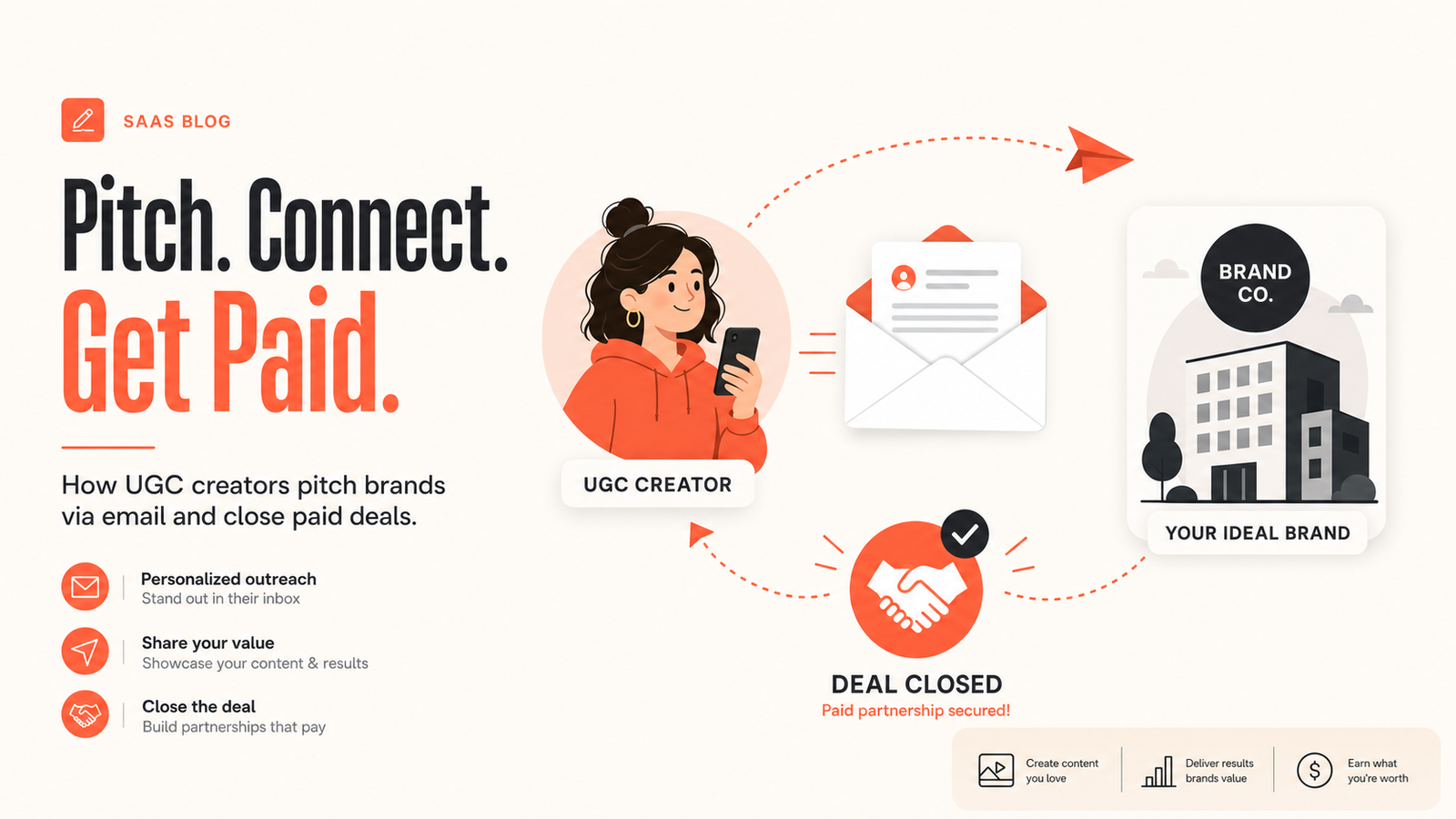
Nobody is going to discover you and hand you a brand deal. Even creators with six-figure followings sit around waiting for DMs that never come. The creators actually getting paid are the ones who pitch — consistently, specifically, and without shame.
Here's the good news: pitching brands is a skill, not a personality trait. You don't need 100K followers, an agent, or a polished media kit designed by a professional. You need a clear offer, a short list of the right brands, a message that respects the person reading it, and a system for following up. That's it.
This is your complete playbook: how to find brands worth pitching, how to find the actual human to email, the exact templates that get replies, how to follow up without being annoying, how to talk rates without underselling yourself — and how to stop doing all of this manually once you've proven the system works.
Before you pitch anything, get your portfolio ready
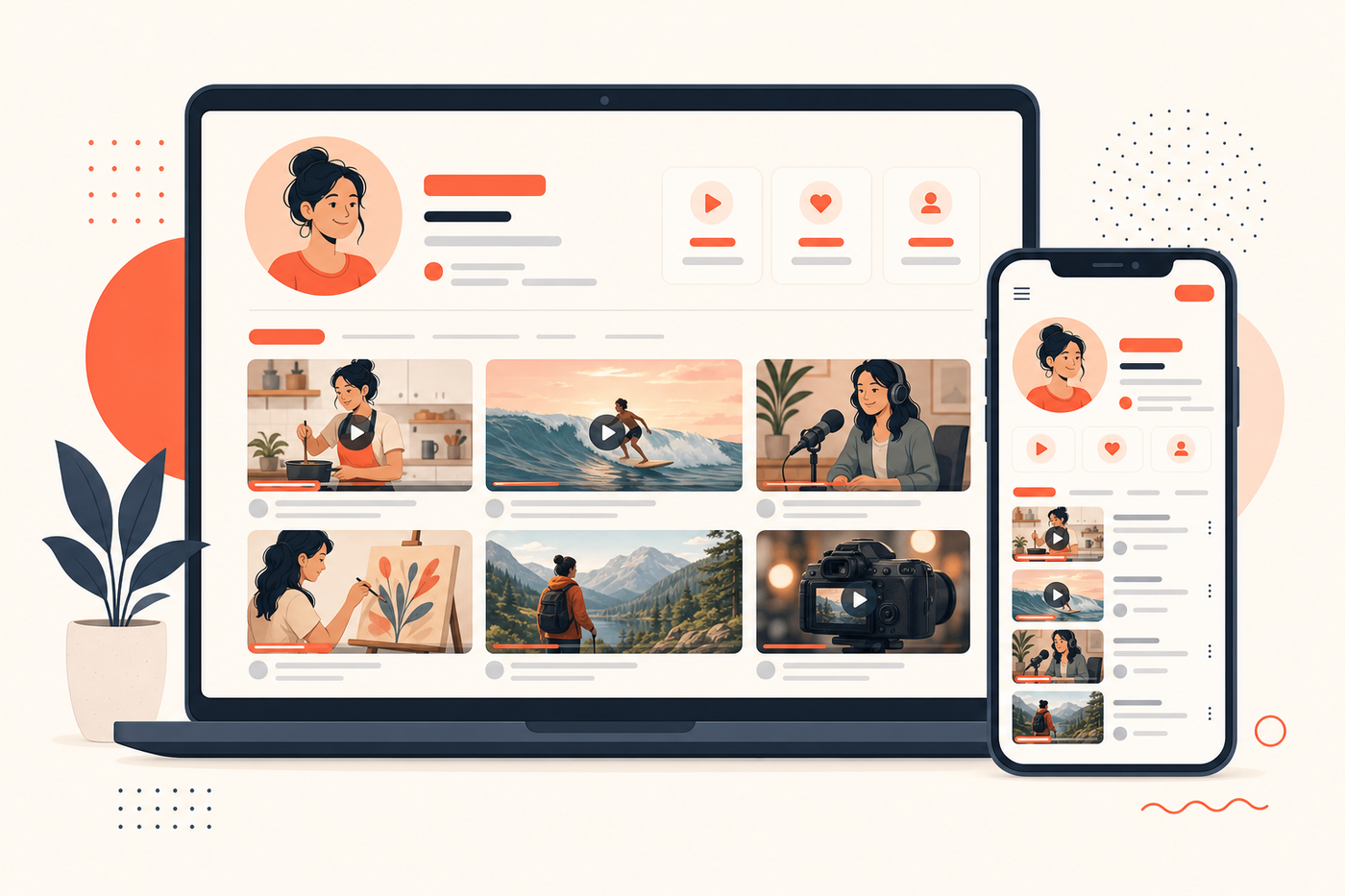
Every brand you cold email is going to do the same thing in the first 10 seconds: click your link and decide if you're legit. If that link goes to a messy Google Drive folder, a TikTok profile with no context, or nothing at all — you've already lost the reply.
You need one link that shows:
- Your best 4–6 pieces of UGC or short-form content
- What niches/products you've created for (even if unpaid or spec work)
- Your rates or a "request rates" option
- A way to contact you
This is exactly what ReelPilot's Portfolio Builder exists for — upload your videos and it builds a shareable portfolio page in about two minutes, detects the brands and hooks in your existing content, and writes case-study style blurbs for you automatically. You get one clean link like reelpilot.co/c/your-name — no decks, no folders, no explaining yourself. It's free for up to 6 videos, so there's no excuse to pitch without one.
If you don't have a portfolio link ready, stop here and build it first. Every template below assumes you have somewhere to send people.
Step 1: Find brands that actually make sense for you
The biggest reason creator pitches get ignored isn't the writing — it's the targeting. A skincare brand doesn't care about your gaming setup content. A B2B SaaS company isn't sponsoring lifestyle vlogs. Before you write a single word, build a short, specific list.
Where to find brands worth pitching:
- Brands you already use and post about organically. These are your warmest leads — you have proof you'd create for them without being paid, which is a stronger pitch than "I'm a fan."
- Competitors of brands you've already worked with. If you did a UGC video for one skincare brand, three of their competitors are a logical next pitch.
- Brands running paid ads with UGC-style creative. Scroll Instagram/TikTok/YouTube ad libraries in your niche. If a brand is already running native-style ads, they have budget for creators — you just need to be the next one in rotation.
- Job boards and gig marketplaces. Curated boards aggregating open UGC and creator gigs (like ReelPilot's Canvas Board) surface brands that are actively looking for creators right now, which converts far better than blind cold outreach to brands with no active program.
- Smaller, newer brands over legacy giants. A brand with 20K followers and a founder who checks their own inbox will reply faster and negotiate more flexibly than a company with a formal agency-run influencer program.
Aim for a list of 20–30 brands per batch. Wide enough that a few say yes, narrow enough that every pitch still feels personal.
Step 2: Find the right person to actually email
"Info@brand.com" is where good pitches go to die. Your message needs to land with someone who can actually say yes.
Fastest ways to find the right contact:
- Check the brand's Instagram/TikTok bio for a partnerships or marketing email — many DTC brands list one directly.
- Search "[Brand] + marketing manager" or "[Brand] + influencer marketing" on LinkedIn. Small-to-mid brands often have one person running the entire creator program.
- Look at the brand's careers page or About page for team names, then guess the email pattern (first@brand.com, first.last@brand.com) — most companies use one consistent format.
- Check who's tagged in other creators' sponsored posts. If another creator credits "@brandname's team" or thanks a specific person, that's your in.
- DM as a fallback, not a first choice, if you truly cannot find an email — but always try to move the conversation to email once there's interest, since email is where budgets and contracts actually get discussed.
This step is the single most time-consuming part of manual outreach — which is exactly why it's the first thing worth automating once you're sending pitches at any real volume (more on that below).
Step 3: What every pitch needs, regardless of format
Brands get flooded with generic "collab?" messages. A message that gets a reply answers four questions in the first few lines, without making the reader work for it:
- Why me? — proof you actually looked at their brand, not a copy-paste template with the name swapped in
- What do you make? — one line about your content, niche, and platform
- What are you asking for? — a paid UGC package, an affiliate arrangement, a whitelisting deal — be specific
- What happens if they say yes? — a simple next step, not a 500-word negotiation
If your message can't answer those four things in under 100 words, it's too long. Brands skim. Respect that.
The 5-part structure behind every strong pitch

Once you internalize this structure, you can write a new, personalized pitch in under three minutes:
- Specific opener — reference something real about the brand (a recent launch, a specific ad you saw, a product you actually use)
- Who you are — one line: niche, platform, content style
- The fit — why your audience/content style matches their product
- The offer — what you're proposing (paid UGC, affiliate, product-for-content, whitelisting)
- The ask — one clear, easy next step
Every template below follows this skeleton. Swap the bracketed sections, keep the structure.
7 copy-paste templates for pitching brands
1. The cold UGC pitch (your default template)
Use this for brands you have no prior relationship with, when you're offering to create content for a fee.
Subject: UGC content idea for [Brand]
Hi [Name],
I've been following [Brand] for a while — [specific detail: loved your recent launch of X / noticed your ads leaning into UGC-style content / use your product myself].
I'm a UGC creator making short-form video for [niche], and I think there's a strong fit between your product and the kind of content I create — [one-line description of your style, e.g. "fast-cut, relatable, no-script demos"].
I'd love to create a paid UGC package for [Brand] — a few short videos you can use on your own paid ads and social. Here's my portfolio: [portfolio link].
If this sounds useful, let me know and I'll send over my rates and turnaround.
Best,
[Your Name]
[Portfolio link] | [Instagram/TikTok handle]
Why it works: it's specific, it names the deliverable, and the CTA is a simple yes/no. Watch-outs: don't skip the specific opener — a generic compliment reads as mass-sent immediately.
2. The "I already use your product" pitch
Your strongest angle when it's true. Organic proof beats any pitch deck.
Subject: Already a fan of [Product] — creator collab idea
Hi [Name],
I've been using [Product] for [timeframe] and honestly didn't expect to reach out about it — but I keep filming content around it without even being asked, and figured I should just say something.
I'm a UGC creator in [niche] with a portfolio here: [portfolio link]. I'd love to turn that into a paid content package for [Brand] — a few videos built the same way I already create, just backed by a proper brief and rate.
Open to sending over rates and a couple of content ideas if you're interested.
Thanks,
[Your Name]
3. The whitelisting / paid ads usage pitch
Use when you're offering content specifically for the brand's paid media, not just organic posting.
Subject: Paid ad creative for [Brand]
Hi [Name],
I noticed [Brand] running ads with a native, creator-style format — that's exactly the kind of content I make. Portfolio here: [portfolio link].
I'd like to pitch a small batch of UGC videos built specifically to perform as paid ad creative — hooks, testimonials, or demo-style content, whichever fits your current campaigns best.
Happy to include usage rights for paid social as part of the package. Let me know if you'd like a quick rate breakdown.
Best,
[Your Name]
4. The affiliate/commission pitch
Use this when you want an ongoing relationship, not a one-off payment — especially for brands without a large upfront budget.
Subject: Affiliate partnership idea — [Your Name] x [Brand]
Hi [Name],
I create UGC content in [niche] and think my audience overlaps well with [Brand]'s customer base. Rather than a one-off paid post, I'd love to explore an affiliate or commission-based partnership — I create content, drive sales through a code/link, and we both benefit from the upside.
Portfolio: [portfolio link]
If you already run a program like this, I'd love to be considered. If not, happy to discuss what a structure like this could look like.
Thanks,
[Your Name]
5. The DM version (short, for Instagram/TikTok)
Use when email isn't available and the brand clearly treats DMs as their front door.
Hey [Name] — I'm a UGC creator in [niche], portfolio here: [link]. Think there could be a good fit for paid content for [Brand]. Happy to send more details here or by email if you have one — let me know!
DM rule: don't try to negotiate rates or scope inside a crowded DM thread. Use the DM to open the door, then move to email.
6. The re-engagement pitch (brand you worked with before)
Past clients are your easiest yes. Don't let them forget you exist.
Subject: New content ideas for [Brand]
Hi [Name],
Loved working together on [previous project/campaign] — it was one of my favorite collabs this year. I've been creating a lot of [new content angle/trend] lately and think it could work really well for [Brand] too.
Would you be open to another round? Happy to send a couple of concept ideas.
Best,
[Your Name]
7. The "seen you're hiring creators" pitch
Use when you spot a brand actively posting a call for creators or UGC applicants.
Subject: Applying — [Your Name], UGC creator
Hi [Name],
Saw you're looking for UGC creators for [Brand/campaign]. I make [niche] content and think my style is a strong fit — portfolio and past examples here: [portfolio link].
Happy to send rates or jump on a quick call if it's useful. Excited about this one.
Best,
[Your Name]
Subject lines that get opened (and ones that don't)
Whoever's inbox you land in is triaging fast. Clear beats clever every time.
Use lines like:
- UGC content idea for [Brand]
- Paid partnership idea — [Your Name]
- Already a fan of [Product] — quick idea
- Applying — UGC creator for [campaign]
Avoid lines like:
- Exciting opportunity!!!
- Collab??
- URGENT: partnership request
- Influencer proposal for review
If your subject line reads like spam, it gets filtered like spam — mentally or literally.
Follow-up templates that don't feel needy

Most creators send one pitch, hear nothing, and give up. That's a mistake — inboxes are noisy and a good follow-up sequence is often what actually gets the reply. Following up isn't rude. Following up five times in three days is.
Follow-up #1 — light bump (send 3–4 days later):
Hi [Name],
Just bumping this in case it got buried — still think there's a great fit here between [Brand] and the kind of UGC content I make. Portfolio again here: [portfolio link].
Happy to send rates whenever works.
Best,
[Your Name]
Follow-up #2 — lower the friction (send about a week after that):
Hi [Name],
Following up one more time. If you're open to creator content right now, I'm happy to send rates directly — no need for a call first if that's easier.
And if timing's off, totally understand.
Best,
[Your Name]
Follow-up #3 — close the loop (final message):
Hi [Name],
Closing the loop on this for now — didn't want to keep bumping your inbox. If a UGC collab makes sense down the line, I'd love to reconnect.
Thanks for reading,
[Your Name]
Three follow-ups, spaced out, is a reasonable rhythm. After that, move on and let your pipeline do the work — which is much easier when you're running dozens of pitches at once instead of tracking three in your head.
How to handle replies (this is where deals are actually won or lost)
Getting a reply is progress, not a deal. What you say next decides whether it moves forward.
If they say yes:
That's great to hear! I'll send over my rates and a couple of content ideas for [Brand]. If it's easier, happy to hop on a quick call too — whatever works best for you.
If they ask for your rates: Don't panic-lowball. Send a real number with a bit of structure:
For [Brand], here's how I'd price this:
- 1 UGC video (no usage rights): $[X]
- 1 UGC video + 3 months paid ad usage rights: $[X]
- Package of 3 videos: $[X]
Happy to adjust based on scope — let me know what fits your budget and I can put together a proposal.
If they offer product only, no payment: It's fine to say no, or to counter:
Thanks for the offer! I typically work on a paid basis for content like this, but I'd be open to a hybrid — product plus a flat fee for the video. Let me know if that could work.
If they go quiet after rates: send Follow-up #2 above. Silence after a rate request usually means budget mismatch, not disinterest — a lower-tier package offer often revives it.
Talking rates without underpricing yourself
New creators lose more money by underquoting than by getting rejected. A few rules:
- Never say "whatever you think is fair." It signals you don't know your own value and invites lowball offers.
- Price the deliverable, not your follower count. A brand paying for content (not reach) cares about production quality, hook strength, and usage rights — not your subscriber number.
- Charge more for usage rights. A video the brand can run as a paid ad for 3–6 months is worth significantly more than one they post once on their own organic feed.
- Bundle for better economics. Offering 3 videos as a package (rather than one-offs) usually gets accepted faster and pays you more per video than negotiating each one separately.
- Have a floor rate and don't go below it in the first message. You can always come down; you can rarely go up mid-negotiation.
Common pitching mistakes that kill replies
- Mass-sending the identical message to 50 brands. It's obvious, and brands can tell.
- Burying the ask. If the brand has to guess what you want, they'll ignore it.
- No portfolio link, or a broken one. This alone kills a huge share of otherwise-good pitches.
- Leading with follower count instead of content quality. Most UGC deals don't require a big following — brands want good content, not reach.
- Writing a wall of text. Your first message should spark interest, not explain the entire relationship.
- Never following up. Most replies come from follow-up #1 or #2, not the first message.
- Going silent after getting a rate objection. A quick, professional counter often saves the deal.
Email vs. DM: when to use which
Use email when: you found a real contact, you're proposing paid work, or the conversation needs to include rates, deliverables, and timelines. Email is where actual deals get discussed and remembered.
Use DM when: you can't find an email, the brand is clearly small/founder-run and DM-first, or you're doing a first light touch before moving to email. Never try to close a full negotiation inside a DM thread — it gets buried and looks unprofessional next to a proper email chain.
The part nobody tells you: pitching is a numbers game until it isn't
Even a great pitch template won't land every time. Expect single-digit reply rates on cold outreach when you're starting out, improving as your portfolio and past brand names build credibility. This is exactly why volume and consistency beat a single "perfect" pitch — the creators landing the most deals are the ones sending the most well-targeted pitches, not the ones agonizing over one email for an hour.
That math is also exactly the problem with doing all of this by hand. Finding brands, finding contacts, writing personalized versions of each template, tracking who replied, and following up on schedule is a part-time job on top of actually making content.
Do this on autopilot with ReelPilot
Once you know the system works, the manual version doesn't scale — and it doesn't need to. ReelPilot's AI Brand Pitching is built to run this entire playbook for you:
- Browse real UGC jobs aggregated daily from across the internet
- Generate personalized pitches for each listing with one click — not a generic template swapped with a name
- Send directly via Gmail so brands reply straight to your inbox
- You approve every pitch before it sends — full control, zero guesswork, none of the manual grind
Start with 5 free AI pitches, upgrade to Pro for 60/month, or go Unlimited for no caps at all.
You focus on creating. ReelPilot handles the outreach.
Join free and start pitching brands →
No credit card required. Free up to 6 videos.
Turn pitching into a full growth loop
Landing brand deals works best alongside a content strategy that's already growing your reach — brands notice creators with momentum. If you're still building views before you start pitching hard, check out how to make a reel go viral for a step-by-step system, or go platform-specific with how to go viral on Instagram Reels. And if brand deals are just one piece of your income plan, see how to monetize YouTube Shorts for the other revenue streams worth stacking alongside UGC work.
Frequently asked questions
How do I pitch a brand with no followers?
Most UGC deals don't require a following at all — brands are paying for content they can post or run as ads themselves, not for your reach. Lead with your portfolio and content quality, not your follower count, and target brands actively looking for UGC creators rather than influencer-style reach deals.
What should a UGC pitch email include?
A specific opener that proves you're not mass-sending, one line about who you are and what you create, a clear statement of the fit between your content and their brand, a defined ask (paid UGC, affiliate, whitelisting), and one easy next step. Keep it under 150 words.
How many brands should I pitch per week?
Aim for at least 15–20 well-targeted pitches per week if you're serious about landing deals consistently. Reply rates on cold outreach are naturally low, so volume — paired with real targeting, not spam — is what produces a steady flow of yeses.
How do I find a brand's email address?
Check their Instagram/TikTok bio first, then search LinkedIn for a marketing or partnerships role at the company, then check the brand's careers or about page for team names and guess the standard email format. DMs are a fallback, not a first choice.
Should I mention my rates in the first pitch?
No — offer to send rates once there's interest instead of leading with them. This keeps the first message light and focused on fit, and it gives you room to tailor pricing once you know the scope of what the brand actually wants.
How long should I wait before following up?
Send your first follow-up 3–4 days after the original pitch, a second follow-up about a week after that, and a final closing message if you still haven't heard back. Three total touches is a reasonable, professional rhythm.
Can I automate brand outreach as a creator?
Yes — tools like ReelPilot's AI Brand Pitching can generate personalized pitches for job listings with one click, send them directly via Gmail, and let you approve every pitch before it goes out. It replaces the manual list-building and templating process described in this guide.