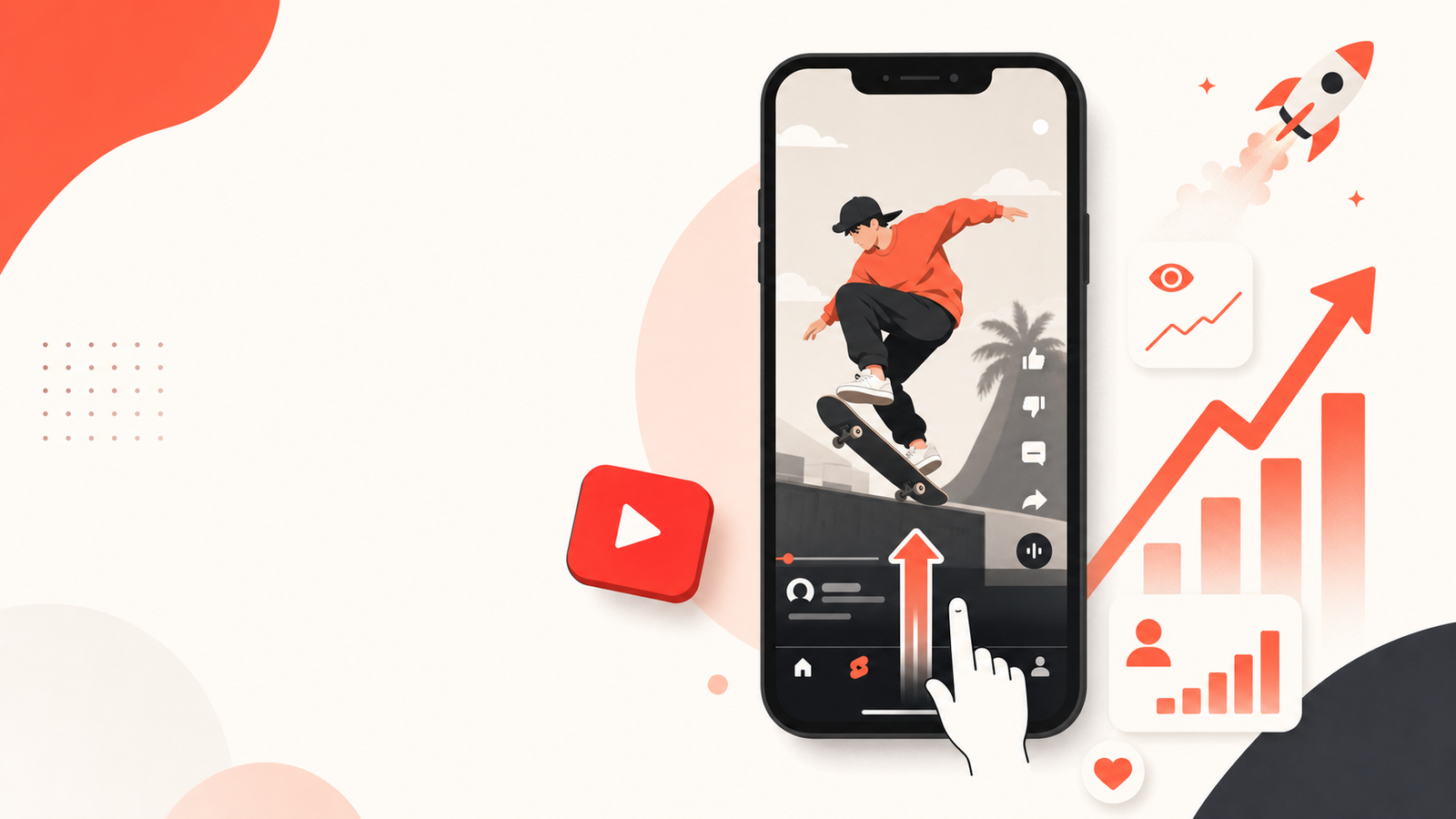
You don't need 100K subscribers to go viral on YouTube Shorts. You need one video the algorithm decides to push — and a system that gives you a lot of chances to make that happen. That's the entire game.
Shorts doesn't care how long you've been posting or how big your channel is. It cares about one thing: does this video keep people watching and swiping to the next one from you. Get that right and YouTube will hand your video to millions of strangers who've never heard of your channel. Get it wrong and it doesn't matter how good your lighting is — nobody sees it.
This guide breaks down exactly how the Shorts algorithm decides what to push, how to build hooks and packaging that stop the scroll, and the posting system that turns "I got lucky once" into "I go viral on a schedule." Stack enough of these views and you're not just growing a channel — you're building proof you can use to land paid brand deals.
How the YouTube Shorts algorithm actually works
Forget subscriber count. The Shorts feed is built to surface whatever keeps people in the feed longest, from whoever made it. That's why brand-new channels regularly outperform accounts that have posted for years.
Here's what YouTube is actually measuring on every Short you post:
- Swipe-away rate — how fast people leave. This is the single biggest signal. A Short that gets swiped away in the first 2 seconds tells the algorithm "don't show this to anyone else."
- Average view duration and replays — did people watch to the end, and did they watch it again? Loops count. A 9-second Short watched twice beats a 60-second Short watched once.
- Engagement — likes, comments, and shares relative to views. Comments especially signal "this made someone feel something."
- Session behavior — did watching your Short lead to a longer overall session for that viewer? YouTube rewards content that keeps people on the app, not just on your video.
YouTube tests every Short with a small pool of viewers first — often people who don't subscribe to you. If retention and engagement clear the bar, it expands to a bigger pool. Clear that bar too, and it keeps scaling. This is why one video can go from 200 views to 5 million: you're not fighting for reach, you're passing a series of retention checkpoints, and each one unlocks a bigger audience.
The practical takeaway: you are graded per-video, not per-channel. Every Short is a fresh lottery ticket. That's good news — it means your worst month doesn't cap your best video.
Retention and swipe-away rate: the metric that decides everything

If you fix only one thing after reading this guide, fix retention. Everything else — hooks, trends, editing — exists to serve this one number.
The first 2 seconds decide the outcome
Thumb is already moving toward the next Short before your video even loads. You have roughly two seconds to give people a reason to stop. That means:
- No logo intros, no "hey guys welcome back," no slow zoom-ins.
- Open mid-action, mid-sentence, or on the most visually surprising frame of the whole video.
- Say the payoff or the tension out loud in the first line — don't build up to it.
Design for loops, not endings
Shorts is a vertical, looping format. A video that ends and loops seamlessly back into itself gets watched 2-3x by the same viewer, and each of those replays counts toward watch time. Structure your last second so it connects naturally back to your first second — a matching visual, a callback line, or a cliffhanger that only makes sense once you've seen the whole thing.
Cut anything that isn't earning its place
Every second where nothing new happens is a second someone can leave. Run this test on your own footage: if you could delete a clip and lose nothing, delete it. Fast cuts, jump cuts, and removing dead air aren't stylistic choices — they're retention tools.
Watch your own Shorts analytics like a scientist
YouTube Studio shows you an audience retention graph for every Short. Look for the exact timestamp where the line drops. That's your leak. Fix that specific second in your next video — don't guess.
Mastering the hook: your thumbnail, title, and first frame
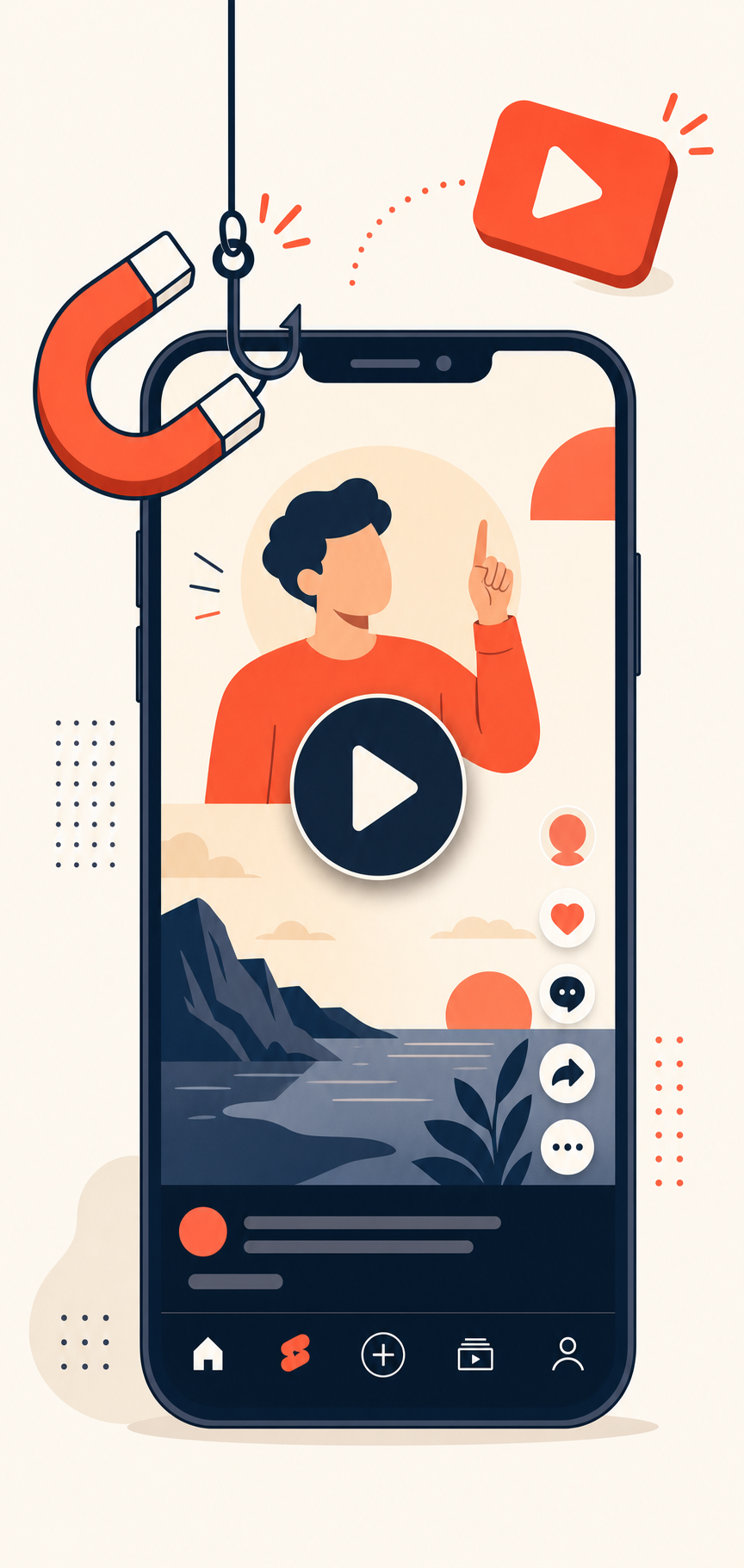
On Shorts, your "thumbnail" is really the first frame people see before they tap in, plus your on-screen text and title working together. Treat all three as one packaging system, not separate afterthoughts.
Hook formulas that consistently work
- The contradiction hook: "This is the wrong way to [common task]" — challenges what viewers assume they know.
- The incomplete pattern: Start an action and cut right before the payoff shows on screen ("watch what happens when I...").
- The stakes hook: State a consequence up front — "I lost $400 doing this so you don't have to."
- The specific number hook: Specificity reads as credibility. "3 seconds" beats "a few seconds."
- The direct callout: Name the exact person this is for — "if you're a UGC creator posting less than 3x a week, watch this."
Titles still matter for search and suggested feed
Shorts also surfaces in search results and on the regular home feed, not just the Shorts shelf. Write titles the way you'd type a question into YouTube search — front-load the keyword, keep it under 40 characters, and make the promise concrete. "How I cut edit time in half" beats "My editing process."
On-screen text is part of the hook, not decoration
Most people watch with sound off for the first second. Your on-screen text needs to carry the hook on its own, independent of your voice.
Riding trends without losing your identity
Trends are a distribution shortcut, not a content strategy. A trending sound or format gets you into a feed that's already primed to watch that type of video — but only if you enter it fast and make it recognizably yours.
- Move within 24-48 hours. Trend lifespan on Shorts is short. By the time a sound feels "big," you may already be late.
- Adapt, don't imitate. Take the trend's structure (a transition, a sound, a challenge format) and run it through your own niche and voice. The version that just copies the original rarely gets pushed as hard as the version that adds something.
- Keep a running trend list. Spend 10 minutes a day scrolling Shorts in your niche and log sounds/formats that are climbing. React within a day or two, not a week.
- Don't abandon your core content to chase every trend. Trends should be maybe 20-30% of your output. The rest should be the format that's already working for your channel — consistency in your niche is what turns viral spikes into actual subscribers.
Posting cadence and the Shorts content system

Virality on Shorts is a numbers game layered on top of a skill. More reps means more shots at clearing the algorithm's retention bar, and more data on what your specific audience responds to.
How often to post
Most creators who break through post daily, or close to it — at minimum 4-5 times a week. This isn't about spamming; it's about giving the algorithm enough fresh signal to learn what your best content looks like, and giving yourself enough attempts to hit a breakout. One video a week means one lottery ticket a week.
Batch to sustain the pace
Daily posting only works if you're not filming daily. Set aside one or two sessions a week to shoot 5-7 Shorts at once, then edit and schedule them out. This is where a lot of creators quietly burn out — solve it with a batching routine, not more hours in the day.
Build a content calendar around formats, not just topics
Instead of asking "what do I post today," keep a rotating list of proven formats (hook + payoff structures that have worked before) and slot new topics into them. This turns content creation into a fill-in-the-blank exercise instead of a blank-page problem every day.
Post consistently at times your audience is active
Check YouTube Studio's "When your viewers are on YouTube" tab and post an hour or two before your audience's peak activity window, so your Short has time to get its first engagement signals in before the crowd shows up.
Common mistakes that quietly kill reach
Most creators who plateau on Shorts aren't failing because of bad ideas -- they're making a handful of fixable, unglamorous mistakes.
- Uploading vertical video with black bars or low resolution. Shorts is a full-screen vertical format. Anything letterboxed reads as an afterthought and hurts watch-through.
- Burying the hook after a setup. If your video needs 5 seconds of context before it gets interesting, restructure it so the interesting part comes first and the context fills in afterward.
- Posting once and moving on. A single upload tells you almost nothing. Patterns only show up after 15-20+ posts.
- Ignoring comments. Replying to comments, especially in the first hour, keeps engagement compounding on a video that's still being tested by the algorithm.
- Copy-pasting a trend without a hook of your own. Trends borrow attention; they don't guarantee retention. If the video itself doesn't hold up in the first 2 seconds, the trend's popularity won't save it.
- Changing niches every week. The algorithm and your audience both need repetition to learn what you're about. Pick a lane, prove it out, then expand.
What to do after a Short actually goes viral
Getting the view spike is only half the win -- what you do in the following 48 hours determines whether it turns into channel growth or just a one-off number.
- Reply to top comments fast. Early engagement on a video that's still climbing tells the algorithm the momentum is real, which can extend how long it keeps getting pushed.
- Post a follow-up within a day. Viral moments create a temporary spike in profile visits. A related video posted quickly gives those new visitors a reason to stick around and subscribe.
- Update your channel's about section and pinned content. New visitors decide whether to subscribe based on what they see next to the viral video -- make sure it's your best, most representative work.
- Screenshot the analytics. Retention graphs, traffic sources, and audience data from a genuine viral hit are gold for both your next content decisions and any brand pitch you send later.
- Don't try to recreate it beat-for-beat. Study what worked structurally (the hook type, the pacing, the payoff) and apply that pattern to a new topic, rather than making a near-identical video that feels stale.
Shorts-specific features worth using
- Shorts remix and "Use this sound" — jumping onto an existing sound's momentum can put your video in front of viewers already primed for that sound's vibe.
- Chaptered / multi-clip Shorts — stitching several quick clips with jump cuts keeps pacing tight, which directly supports retention.
- Shorts-native text and stickers — using YouTube's built-in text tools (vs. baking text in during editing) can help the platform read and categorize your content correctly.
- End screens and pinned comments — you can't always add a clickable link, but a pinned comment with context or a call-to-action ("full version on my channel") extends the value of a viral moment.
- Community posts and polls — engaging your existing audience between Shorts keeps your channel's overall engagement rate healthy, which the algorithm also weighs.
Turning viral Shorts into paid work, not just views
Here's what most creators miss: a viral Short is worth more than the ad pennies it generates. It's proof. A 2-million-view Short with strong retention is exactly the kind of evidence brands look for before they pay someone to make UGC content.
The problem is most creators have no clean way to show that off — it's buried three scrolls down on a channel page next to a dozen flops. That's the exact gap ReelPilot's Portfolio Builder fills: you upload your best Shorts, and it automatically builds a shareable portfolio page — detecting the brands and hooks you've used and writing case studies around your top performers. One link, no decks, nothing to design. Brands can see your best work in ten seconds instead of digging through your channel.
Growing views and building a portfolio aren't two separate jobs anymore — every viral Short you post should be doing double duty. If you're ready to see the full path from views to income, our companion guide on how to monetize YouTube Shorts walks through ad revenue, UGC gigs, and brand deals in detail.
Niche-proofing your growth: what changes by content category
The core mechanics (retention, hooks, cadence) apply across every niche, but how you execute them shifts depending on what you make.
Talking-head and advice content
Your hook has to be a spoken claim or question, not just a visual. Get to the specific promise in your first sentence ('Here's the mistake killing your retention') rather than warming up with context. Jump cuts every 2-3 seconds keep pacing tight since there's no inherent visual movement to hold attention.
Comedy and skits
The setup has to be nearly invisible. Viewers on Shorts have seen thousands of skits; anything that telegraphs the punchline early gets swiped past. Front-load a visual or line that makes the premise ambiguous just long enough to hold attention until the twist lands.
Tutorials and how-to content
Show the result first, then the process. 'Here's the final look' followed by 'here's how' consistently retains better than a chronological walkthrough, because you've already answered 'is this worth my time' in the first two seconds.
Product and UGC-style demos
Treat the product like a supporting character, not the star. The hook should be about the problem or transformation, with the product entering naturally once attention is already earned. This is also the exact skill brands pay for in UGC work, so practicing this style on your own channel doubles as a portfolio piece.
Storytelling and personal content
Open mid-story, at the most tension-filled moment, then loop back to explain how you got there. Straight chronological storytelling ('so it all started when...') loses viewers before the interesting part even begins.
Your roadmap: putting it all together
- Audit your last 10 Shorts in YouTube Studio. Find the average timestamp where retention drops and fix that specific issue first.
- Rebuild your hook formula. Script your first 2 seconds before you script anything else.
- Set a posting cadence you can actually sustain — daily is ideal, 4-5x/week is the floor. Batch-film weekly.
- Ride one trend a week, adapted to your niche, without abandoning your core format.
- Track what repeats. When a format or hook outperforms, make a near-duplicate before moving on — winners on Shorts tend to cluster.
- Turn your best 5-10 Shorts into a portfolio so every viral moment compounds into future paid opportunities, not just a view count.
Everything here also applies, with small tweaks, to other short-form platforms — if you're cross-posting, check out our guides on how to go viral on Instagram Reels and the broader playbook for making a reel go viral.
Tools that make the system sustainable
A repeatable viral system depends on more than talent -- it depends on infrastructure you don't have to rebuild every week. A simple stack worth setting up early:
- A running hook and trend log (a plain doc or spreadsheet works fine) so you're never starting from a blank page on filming day.
- A batching schedule that protects one or two dedicated filming blocks a week, so daily posting doesn't mean daily filming.
- A retention review habit -- 15 minutes a week in YouTube Studio checking where your last batch of Shorts lost viewers.
- A portfolio that updates itself. As your best Shorts change month to month, your proof of skill should keep pace without manual upkeep. This is exactly the gap a tool like ReelPilot is built to close -- it keeps your strongest work front and center automatically.
None of this replaces creativity or reps. It just makes sure the reps compound instead of resetting to zero every week.
Build a portfolio from your best Shorts
You're already making the content. Don't let your best-performing Shorts just sit there as a view count. Build a free portfolio with ReelPilot in about two minutes — upload your videos, and it turns your top Shorts into a shareable page brands can actually use to say yes. Free for up to 6 videos, no design work required.
Frequently asked questions
How many views do I need to go viral on YouTube Shorts?
There's no fixed number — "viral" is relative to your channel's normal average. For a small channel, a Short pulling in 20-50x your usual views counts as a genuine viral moment. What matters more than the raw number is that the algorithm pushed it well past your existing audience, which is the real signal something worked.
Does posting daily actually help the algorithm favor you?
Yes, indirectly. Posting daily doesn't give you a ranking boost by itself, but it multiplies your chances of hitting the retention and engagement thresholds that do get rewarded, and it gives you faster feedback on what's working so you can repeat it sooner.
Why did my Short get views but no subscribers?
Viral Shorts often get discovered by an audience outside your niche, so a lot of viewers watch, enjoy it, and move on without subscribing. To convert more of them, make sure your channel name, profile picture, and pinned content clearly signal what else you post, and consider a soft call-to-action ("more like this every week") in your on-screen text or pinned comment.
Do hashtags matter for the Shorts algorithm?
Hashtags help with categorization and search more than they drive raw reach. A couple of relevant hashtags won't hurt, but they're not a substitute for a strong hook and high retention — don't spend more than a minute on them per video.
Should I repost my Instagram Reels or TikToks as YouTube Shorts?
You can, but native, unwatermarked uploads tend to perform better since YouTube can be less favorable toward content carrying another platform's watermark. If you're repurposing across platforms, re-export clean versions for each one when you can.
How long should a YouTube Short be to maximize views?
Shorter isn't automatically better — a tightly edited 15-25 second video that's watched in full and looped often outperforms a slower 60-second one. Match length to how much story or value you actually have; don't pad runtime just to hit a number.
Can a channel with zero subscribers still go viral?
Yes — this is actually one of the biggest advantages of Shorts over long-form video. The algorithm tests every video against a small viewer pool regardless of channel size, so a brand-new account with strong retention on video one can outperform an established channel's average upload.