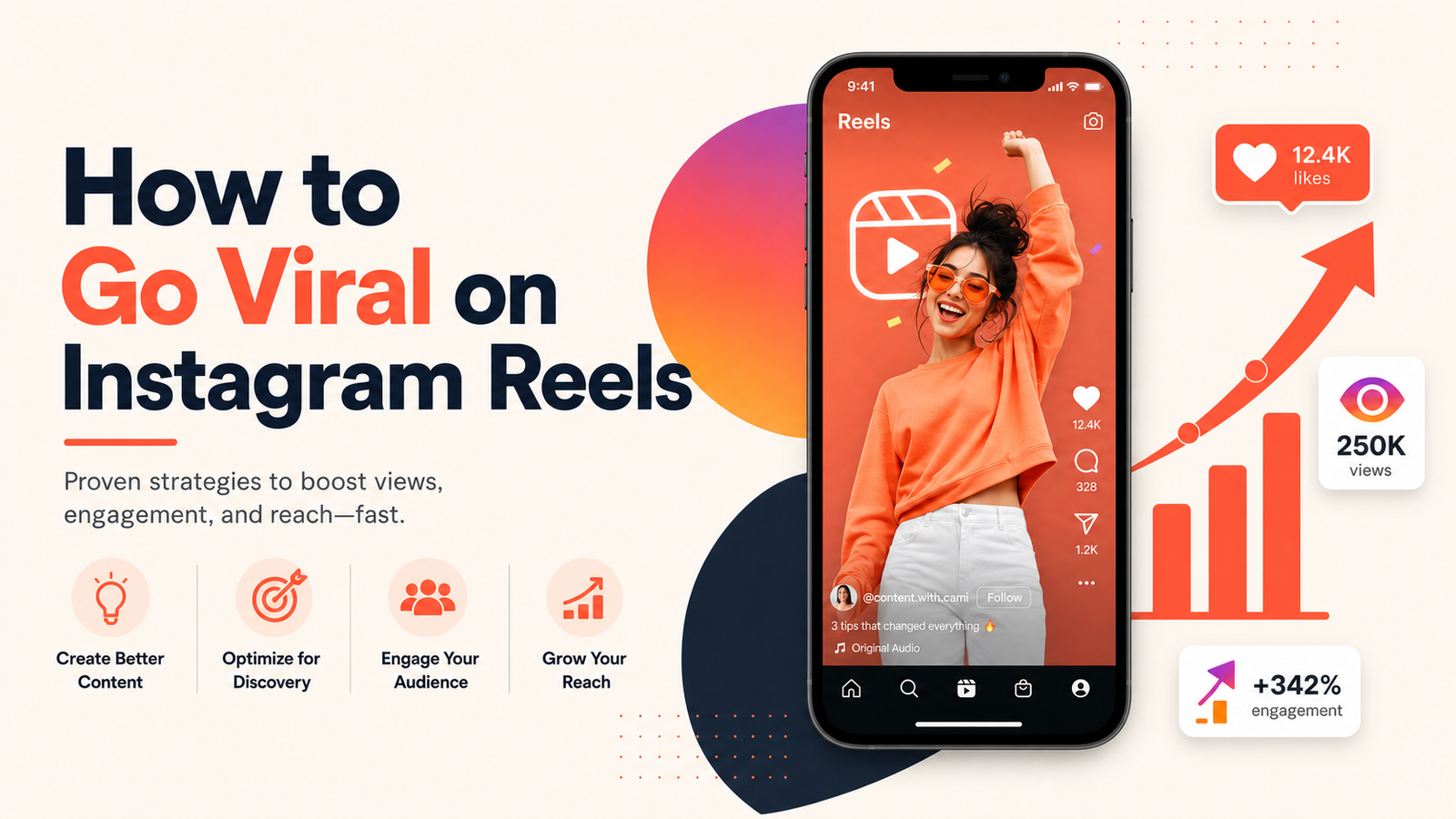
Instagram Reels isn't TikTok with a different logo, and treating it that way is why a lot of creators plateau. The app rewards specific behaviors — watch time and engagement velocity above almost everything else — and once you understand exactly what those mean, you stop guessing and start engineering.
This is the Instagram-specific playbook: what the algorithm actually looks for, how to win the first three seconds, how to use trends without losing your identity, and how to build a posting rhythm that compounds instead of resetting every week. If you haven't already, pair this with the universal system for making a reel go viral — that guide covers the hook-and-retention fundamentals that apply everywhere. This one is about winning inside Instagram's specific rules.
By the end, you'll know exactly how to structure a Reel for Instagram's algorithm — and how to turn a viral moment into something more durable than a good week of views.
What the Instagram Reels algorithm actually looks for

Instagram's whole business model is keeping people scrolling. Your Reel is a tool that either helps with that job or doesn't — and the algorithm is blunt about how it decides which Reels get pushed further.
Two signals matter more than anything else:
Watch time. The total time people spend watching your Reel, including replays. A high completion rate — especially on a shorter video — is one of the strongest signals you can send. Instagram isn't just asking "did they watch it," it's asking "did they watch the whole thing, and did they watch it again."
Engagement velocity. How fast your Reel picks up likes, comments, shares, and saves right after posting. A quick burst of interaction in the first 30-60 minutes tells Instagram "this is resonating right now" — and it tests the Reel with a wider audience faster than a slow trickle of engagement would.
Everything else — hashtags, captions, trending audio, posting time — exists to support those two signals. None of it substitutes for them.
Optimizing for watch time
Shorter isn't automatically better, but it's the safer default if your goal is a high completion rate. The pattern holds across the platform: the longer the video, the more people drop off before the end. A tight Reel that gets watched start to finish — and ideally replayed — sends a much stronger signal than a longer one that loses half its audience by the midpoint.
The goal isn't just "get to the end." It's making something dense or satisfying enough that people hit replay without thinking about it — a loopable ending, a quick payoff, a visual that rewards a second look.
Why early engagement is your fuel
Reels consistently outperform static photo posts for one simple reason: video invites more interaction — comments, shares, saves — than a static image ever will. That's structural, not incidental, and it's a big part of why Instagram keeps pushing creators toward Reels over feed posts.
Because engagement velocity matters so much, the first hour after you post is not passive time. Reply to every comment immediately. Share the Reel to your Story to give it an early push. If you have any way to alert your closest engaged followers (a broadcast channel, a Close Friends list), use it — that early spike is what earns the second wave of distribution.
Mastering the make-or-break first 3 seconds
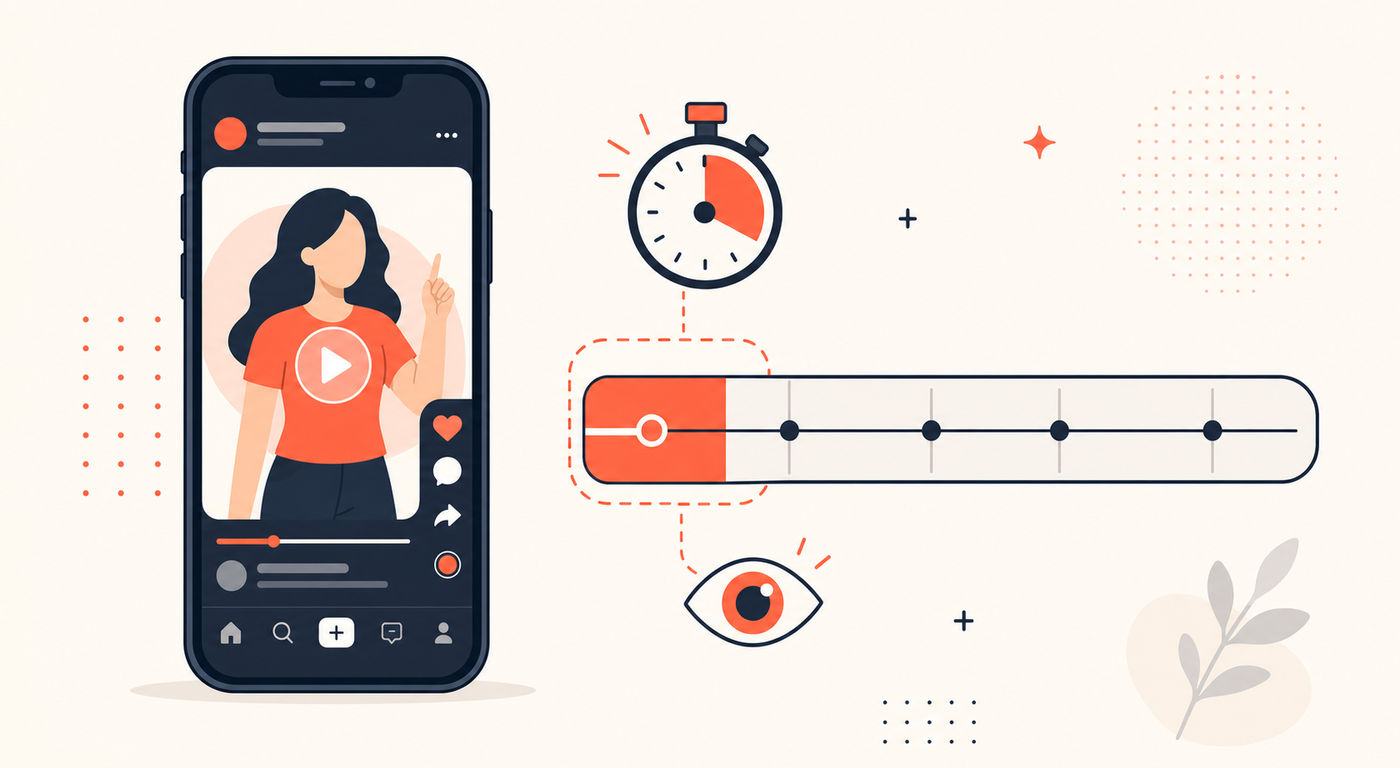
You have less than a second to earn a stop, and about three seconds to earn a "keep watching." On Instagram specifically, a few hook types consistently outperform:
- Visual pattern interrupts — motion, a jump cut, or an unexpected image in frame one, before any words are spoken.
- A bold, specific claim — "This is the reason your Reels aren't getting reach" lands harder than "let's talk about Reels."
- On-screen text that names the exact problem — text overlays get read even with sound off, and a huge share of Reels are watched muted, especially in public or on mobile data.
- A cold open — start mid-action with zero setup, so understanding what's happening becomes the reason to keep watching.
Avoid slow intros, logos, "hey guys welcome back," or any setup that delays the actual content. Every second before the value starts is a second where someone can swipe away — and on Instagram, that swipe is instant and easy.
Riding trends without losing your identity
Trending audio and formats can give you a small discovery boost, because Instagram surfaces Reels using popular sounds to more people exploring that trend. But blindly copying a trend without adapting it to your niche is a fast way to get views that don't convert into followers or brand interest.
The move: take the structure of a trend — the timing, the format, the joke pattern — and fill it with content specific to your niche and voice. A trend executed generically gets lost in a sea of identical Reels. A trend executed with your specific angle stands out inside the trend itself, and it still attracts people who'll actually stick around for your other content.
Don't force a trend that doesn't fit your content pillar just because it's popular. Views from a mismatched trend rarely convert to real audience growth, and they can actually dilute what your account is "about" in the eyes of both the algorithm and new visitors checking your profile.
Unlocking your reach beyond your existing followers
One of the biggest advantages of Reels over regular feed posts is that reach isn't capped by your follower count. Instagram actively pushes Reels to non-followers through the Reels tab and Explore, based purely on performance signals — not who already follows you.
That means a small account can absolutely outperform a big one on a single Reel, if the hook and retention are strong enough. It also means you shouldn't obsess over follower count as the metric that matters — a highly engaged, smaller audience that saves and shares consistently will outperform a large, passive one over time.
To lean into this:
- Post consistently enough that the algorithm has fresh signal to test regularly (see posting cadence below).
- Make each Reel able to stand alone — don't assume the viewer has seen your other content or knows who you are.
- Use the first frame to establish context fast, since most new viewers arrive with zero prior context.
Building real engagement that fuels sustained growth
Views spike and fade. Real growth on Instagram comes from turning viewers into people who engage repeatedly — comment, save, come back to your profile.
- Ask a specific, easy-to-answer question in your caption or on-screen — vague CTAs like "thoughts?" underperform specific ones like "which one would you actually use — 1 or 2?"
- Reply to comments with more than one word. A real reply often earns a reply back, and that thread keeps the Reel "active" in the algorithm's eyes longer.
- Use Stories to extend the conversation — polls, question stickers, and reshares of your own Reel keep it circulating among people who already know you.
- Post follow-up content referencing a Reel that performed well — "you guys asked about X, here's part 2" — turns one viral moment into two or three.
Perfecting your posting strategy
There's no universal "best time to post" that works for every account — it depends on when your specific audience is active. But a few structural rules hold up:
- Consistency beats frequency. Posting 4-5 times a week reliably outperforms posting 10 times one week and going silent the next. The algorithm rewards accounts it can test regularly.
- Check your own insights, not generic "best time" charts. Your audience's active hours are specific to your niche and geography.
- Give each Reel room to breathe. Posting multiple Reels back-to-back within the same hour can split your own audience's attention and engagement signals across posts instead of concentrating them.
- Batch your content creation, but stagger your posting. Film and edit in batches for efficiency, but space out publishing to maintain a steady cadence.
Do hashtags still matter on Instagram Reels?
Hashtags on Reels are a minor categorization signal, not a growth lever. They can help the algorithm understand what your content is about, which matters slightly for reaching people actively exploring a topic, but they will not rescue a weak hook or save a Reel with poor retention.
A practical approach: use 3-5 specific, relevant hashtags rather than 20 generic ones. Mix a couple of broad category tags with one or two niche-specific ones that match your exact content. Skip hashtag stuffing entirely — it reads as spammy to viewers and does nothing meaningful for distribution. Put your effort into the caption's first line instead, since that's what shows before someone taps "more" — treat it as a second hook, not an afterthought.
Where Reels actually get discovered
Instagram surfaces Reels to non-followers through a handful of specific surfaces, and understanding each one changes how you think about optimization:
- The Reels tab — a dedicated, full-screen feed of Reels shown based on performance and relevance to the viewer's interests. This is the biggest source of non-follower reach.
- Explore — surfaces Reels alongside other content formats based on a viewer's browsing behavior and past engagement.
- Hashtag and audio pages — viewers actively browsing a specific sound or tag will see top-performing Reels using it, which is where a trending audio choice can add a modest boost.
- Your followers' feeds and Stories — your existing audience is your fastest engagement source and often the difference between a Reel that gets tested wider and one that doesn't.
Because the Reels tab and Explore reward performance signals over follower relationships, a new account with zero history can still get pushed to a large audience on a single strong Reel — there's no follower threshold you need to cross first.
Cross-posting: should you reuse TikToks as Instagram Reels?
Reusing content across platforms is efficient, but posting an identical TikTok export — watermark and all — onto Reels usually underperforms. Instagram's own systems can deprioritize visibly reposted content, and viewers notice the mismatched aspect ratio, captions, or watermark even if the algorithm didn't care.
If you're repurposing a format that worked on another platform, re-edit it for Instagram: strip any competing watermark, adjust captions to Instagram's on-screen style, and consider re-cutting the pacing slightly, since Instagram audiences and TikTok audiences don't always respond to identical edits. Treat cross-posting as a starting template, not a copy-paste job.
Common mistakes that quietly cap your reach on Instagram
- Leading with a logo, intro animation, or "hi guys." Every second before value starts is a chance for a swipe-away, and Instagram's audience swipes fast.
- Relying on hashtags or trending audio to fix a weak hook. Neither compensates for the first three seconds falling flat.
- Posting once and disappearing for a week. Inconsistent posting gives the algorithm less signal to test your account against, which slows how quickly new Reels get distributed.
- Chasing every trend regardless of fit. Mismatched trend content can pull in viewers who bounce immediately and don't represent your actual audience.
- Ignoring the first hour after posting. Engagement velocity is time-sensitive — replying to comments and sharing to your Story an hour after posting is far less effective than doing it in the first few minutes.
- Judging performance by views alone. Two Reels with identical view counts can have very different save, share, and comment rates — and very different value to your growth.
Turning a viral moment into lasting growth
A Reel that hits big is a moment. A content system is what turns that moment into a career. Once you have a Reel that performs:
- Study it like data, not luck. What was the exact hook? Where were the cuts? Was there a trending sound or original audio telling a story? What was the pacing?
- Turn it into a format, not a one-off. Same structure, new topic — build a series around what worked.
- Set goals beyond the view count. A follower-to-engagement ratio, profile visits, DMs from brands, or traffic to your portfolio link are all more durable indicators of growth than a single spike in views.
The creators who turn viral moments into sustainable income are the ones who track what's actually working across their content — not just chasing the next lucky post.
Reading your Reels insights like an operator

Instagram gives you more data than most creators actually use. Beyond the headline view count, a few metrics deserve regular attention:
- Average watch time and completion rate — your clearest signal of whether the hook and pacing are working. A completion rate that drops sharply at a specific timestamp tells you exactly where viewers lose interest.
- Plays vs. accounts reached — a big gap between plays and unique accounts reached usually means people are replaying the Reel, which is a strong positive signal.
- Shares — one of the clearest indicators of social value. A Reel with a high share-to-view ratio is punching above its raw view count.
- Follows from this Reel — shows whether the content actually converts viewers into an audience, not just eyeballs.
- Profile visits after viewing — a strong signal that the Reel earned curiosity about who made it, which matters if your goal includes brand visibility.
Check these numbers within the first 24-48 hours and again after a week. A Reel that keeps climbing in reach a week later is being actively pushed by the algorithm — worth studying closely for what made it stick.
Turn viral Reels into brand deals
A viral Reel is proof of skill — but only if you can show it off in a way brands can actually evaluate quickly. Screenshotting your analytics into a deck or sending a folder of MP4s doesn't cut it when a brand is scanning dozens of creators.
ReelPilot's Portfolio Builder turns your best-performing Reels into a clean, shareable portfolio page in about two minutes. It automatically detects the brands and hooks featured in your videos and writes case studies around them — so instead of explaining your reach in a DM, you send one link: reelpilot.co/c/your-name. It's free for up to 6 videos.
Build your portfolio free → app.reelpilot.co/join
Once it's live, drop that link in your bio and pitch decks, or browse Canvas Board for paid UGC gigs that pay per video or per view — so your Instagram growth starts converting into income, not just impressions.
For the platform-agnostic fundamentals behind everything in this guide, read how to make a reel go viral. If you're also posting to YouTube, check out how to go viral on YouTube Shorts and how to monetize YouTube Shorts. And once brands start noticing your Reels, learn how creators pitch brands to turn that attention into paid deals.
Frequently asked questions
What does the Instagram Reels algorithm actually prioritize?
Watch time (including replays) and engagement velocity — how fast a Reel earns likes, comments, shares, and saves after posting. Both signals tell Instagram whether to keep testing your Reel with a wider audience.
How long should an Instagram Reel be to go viral?
Shorter Reels tend to get higher completion rates, which is a strong positive signal. There's no fixed ideal length, but a tight Reel that gets watched fully and replayed usually outperforms a longer one with a steep drop-off. Prioritize pacing over hitting a specific runtime.
How do I grab attention in the first 3 seconds on Instagram specifically?
Skip intros and logos entirely. Use a visual pattern interrupt, a bold on-screen claim, or a cold open that starts mid-action. Since a large share of Reels are watched muted, make sure your hook works with on-screen text alone, not just narration.
Is it bad to just copy trending audio and formats?
Copying a trend generically can get you a small reach bump but rarely builds lasting audience growth. The better approach is borrowing the structure of a trend — timing, format, joke pattern — and filling it with content specific to your niche so it still represents your voice.
How often should I post Reels to grow on Instagram?
Consistency matters more than raw frequency. Posting 4-5 times a week reliably beats bursts of 10 posts followed by silence, because the algorithm needs a steady stream of fresh content to keep testing your account.
Does follower count limit how far a Reel can spread?
No. Instagram distributes Reels through the Reels tab and Explore based on performance signals, not existing followers. A small account with a strong hook and fast early engagement can outperform a much larger one on a single Reel.
What's the best time to post Reels on Instagram?
There's no universal best time — it depends on when your specific audience is active. Check your own account insights rather than generic timing charts, and prioritize consistency over chasing an exact posting hour.
How many hashtags should I use on a Reel?
Use 3-5 specific, relevant hashtags rather than stuffing in 20 generic ones. Hashtags are a minor categorization signal, not a growth driver — they won't rescue a Reel with a weak hook or poor retention, so don't spend more time on hashtag research than on the actual hook.